
An aeronautical engineer who became
Indonesia'sminister of technical development and eventually its president, B.J.
Habibie (born 1936) was a lifelong devotee of Indonesian dictator Suharto. When
student riots and economic turmoil forced Suharto from office, he named Habibie
as his successor.
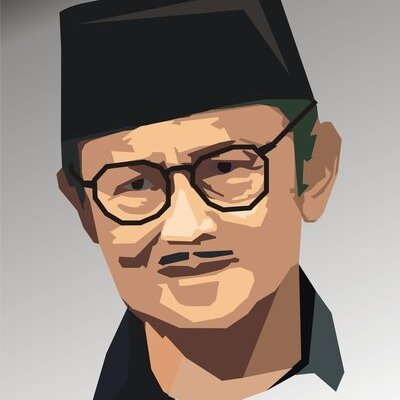
Known as a big-government free-spender and a
proponent of bizarre economic theories, Habibie seemed an unlikely candidate to
bail out Indonesia from its severe economic crisis of the late 1990s. He was
closely identified with Suharto's corrupt policies and distrusted by students,
the military, and foreign investors. Yet he instituted reforms and steered the
country toward free elections, remaining in power longer than most observers
expected.
Father Figure
Bacharuddin
Jusuf Habibie was born on June 25, 1936 in the sleepy seaside town of Pare Pare
in the Indonesian state of South Sulawesi. The fourth of eight children, he was
nicknamed "Rudy" at an early age. His father, Alwi Abdul Jalil
Habibie, was a government agricultural official who promoted the cultivation of
cloves and peanuts. His grandfather was a Muslim leader and an affluent
landowner.
As
a child Habibie liked swimming, reading, singing, riding his father's
racehorses, and building model airplanes. In 1950, when Rudy was 13, his father
suffered a heart attack and died. Suharto, then a young military officer
billeted across the street, was present at his father's deathbed and became Habibie's
protector and substitute father. Habibie later wrote of Suharto: "I
regarded him as an idol, who could serve as an example for all people … a
young, taciturn brigade commander, with great humane feelings, and a fierce
fighting spirit." Suharto's autobiography said Habibie "regards me as
his own parent. He always asks for my guidance and takes down notes on
philosophy."
Habibie's
interest in building model planes continued while he excelled in science and
mathematics at the Bandung Institute of Technology. His mother, R.A. Tuti
Marini Habibie, arranged for him to continue his studies in Germany. At the
Technische Hochschule of Aachen, Habibie studied aircraft construction
engineering.
In
1962, on a visit home to Indonesia, he married H. Hasri Ainun Besari, a doctor.
They had two children, Ilham Akbar and Thareq Kemal, both born in Germany.
While Habibie was abroad, Suharto, who had become a general, succeeded General
Sukarno as Indonesia's ruler in 1966.
After
graduating with a doctoral degree from the Aachen Institute in 1965, Habibie
joined the aircraft manufacturing firm Messerschmitt-Boelkow-Bluhm, rising to
the rank of vice-president. As a research scientist and aeronautical engineer,
he helped design several planes, including the DO-31, an innovative vertical
takeoff and landing craft. He specialized in solutions for aircraft cracking,
gaining the nickname "Mr. Crack" as one of the first scientists to
calculate the dynamics of random crack propagation. He also became involved in
international aircraft marketing activities and NATO's defense and economic
development.
Indonesia's Technology Czar

In
1974, Suharto asked Habibie to return to Indonesia to help establish an
industrial base. Habibie jump-started an aircraft construction industry and a
state airline company. Soon he became Suharto's chief advisor for
high-technology development. Habibie exploited the relationships he had
developed in Germany and NATO to engineer a myriad of controversial deals
involving aircraft, ships, heavy industry, and economic development.
As
minister of research and technology, Habibie promoted the importation of
high-tech goods and services. He liked to "leapfrog" over low-skill
industries and move straight into high-tech ventures, spurning the basic
development which might have brought needed employment to Indonesia's
low-skilled masses. Habibie spent billions in public money on his strategic
companies. His pet project was a national airplane, the propeller-driven N-250.
Its producer was IPTN, a state company whose vice-president was Habibie's son.
The national airplane venture consumed $2 billion in public funds, diverted
from a project to save Indonesian forests.
Habibie
often used his influence with Suharto to broker favorable deals for his family
companies. For example, he pressured Merpati Airlines to buy 16 of IPTN's
CN-235 airplanes, which were so poorly built they could fly for only an hour
with a full load. Never popular with the military, Habibie angered officials by
buying 100 German naval vessels without consulting top brass; the ships needed
$1 billion in repairs.
For
two decades, Habibie was a top insider in Suharto's corrupt, nepotistic regime.
Like Suharto, whose family controlled much of Indonesia's economy, Habibie's
relatives had their own business monopolies, often in partnership with
Suharto's children. According to Philadelphia Inquirer reporter Trudy Rubin, "The state
set up Habibie's 'strategic industries' in fields such as steel, shipbuilding
and, especially, aircraft manufacture. His relatives were all involved as
middlemen, agents, and supp liers." Habibie's family came to control two
conglomerates-the Timsco Group, named after his brother Timmy, and the Repindo
Panca Group, headed by his second son, Tareq Kamal Habibie. The conglomerate's
66 companies benefited from lucrative government contracts awarded by minister
Habibie.
Habibie
was widely known as a free-spending eccentric and an advocate of expensive
government programs. His high-tech ventures failed to strengthen Indonesia's
economy. Many of his projects lost millions of dollars. A relentless
self-promoter, Habibie was known for talking endlessly in shrill tones while
gesturing wildly. When he visited Tokyo to talk to Japanese bankers about
refinancing Indonesia's $80 billion debt, he lectured them for two hours about
what was wrong with the Japanese economy and came home empty-handed.
A
small, wiry man, Habibie enjoyed classical music, motorcycle riding and
swimming in his pool at his home on Jalan Cibubur. A devout Muslim, he founded
the Indonesian Association of Muslim Intellectuals in 1990.
Suharto's Man

Throughout
his long tenure as technology minister, Habibie remained slavishly loyal to
Suharto, and Suharto considered him his most reliable supporter. Habibie told
Newsweekthat Suharto was his "close friend" who "treated me like
his own brother." Habibie often called the dictator "SGS," for
"Super-Genius Suharto."
Eventually,
Suharto's policies brought Indonesia's economy to the brink of disaster. In
March 1998, as student demonstrations and civil unrest increased in intensity,
Suharto installed Habibie as vice-president. As the economy collapsed, bloody
student riots led to increasing calls from international allies for Suharto's
resignation. Hundreds died in the civil unrest that finally forced Suharto from
office in May 1998. Before he left the presidential palace, Suharto installed
Habibie as his hand-picked successor.
The
appointment of Habibie to head the troubled country seemed to appease no one.
Protesters saw him as firmly tied to Suharto's system. Even after Suharto
stepped down, the general's family members still controlled commerce and
industry in the country. Foreign investors worried that Habibie's free-spending
policies would exacerbate Indonesia's problems. The military distrusted him
because, unlike previous Indonesian presidents, Habibie did not rise through their
ranks.
On
taking power, Habibie tried to distance himself somewhat from his lifelong
idol. He pledged to build "a clean government, free from inefficiency,
corruption, collusion, and nepotism." Soon after, Habibie's brother
resigned from his leadership of an industrial development authority. He also
freed high-profile political prisoners; lifted controls on the press, political
parties and labor unions, and pledged negotiations to end the long conflict in
the Indonesian state of East Timor.
Most
observers doubted he could retain his power for several reasons. His reputation
for wild spending came at a time when the failing Indonesian economy needed a
bailout. The bankrupt Indonesian currency, the rupiah, fell in value by 36 percent when
Habibie took office. Most of the country identified him closely with Suharto's
regime and its policies, which had brought unbearable hyper-inflation and food
lines.
"Indonesia's
problems are so difficult to solve that not even an extraordinarily clever
politician bolstered by overwhelming public support would find it easy to take
over," observed Time magazine. "And Habibie … seems
the least likely candidate. He has no political base, nor can he necessarily
count on the long-term backing of the powerful military. Economists and stock
analysts around Asia question Habibie's ability to bring sensible change to
Indonesia's choking economy … "
Many
foreign investors found a Habibie presidency frightening. One reason was
Habibie's advocacy of a strange "zig-zag theory" of economics. He
believed that cutting interest rates, then doubling them, then slashing them
again, would reduce inflation. Critics scoffed at his abilities. "He is a
clown, a joker, an entertainer," said Jusuf Wanandi, director of the
Centre for Strategic and International Studies in Jakarta. Yet Habibie managed
to consolidate his control over the country, primarily because the opposition
was fragmented and frequently squabbling. The military, involved in government
at every level, was deeply divided. Never modest, Habibie told Time: "There are two ways of making
history: from within the elite-or from the outside. Being inside doesn't mean
you're a puppet."
As
Habibie maintained a grip on power, the economic decline of his country
worsened, with one-fifth of the work force unemployed by the end of 1998.
Unrest continued, and there were reports of the torture of dissidents by the
military and new assaults on rebel sympathizers in East Timor. During renewed
demonstrations by student protesters against the government in November 1998,
16 people died. Habibie enraged students by arresting a small group of
dissidents and blaming them for provoking soldiers. Protesters demanded that
Habibie step down. The armed forces insisted only rubber bullets and blanks had
been used against protesters, but it was discovered that at least one student
had been killed by live ammunition, a "dum-dum" bullet outlawed under
the Geneva Convention's international rules of warfare. The military then tried
to appease the protesters by announcing prosecutions of 163 soldiers and
police. Habibie tried to downplay the conflict. "Our society still has not
had the chance to live under the rule of law," Habibie told Newsweek. "The police do not understand the
limits, though they are learning."
Renewed
hostilities by Islamic militants against Indonesia's ethnic Chinese Christian
minority raised questions about Habibie's goals. His religious supporters
dreamed of him instituting a fundamentalist Muslim state. But Habibie told Newsweek: "The burning of churches and
mosques is a criminal act we all condemn. … As a religious and intellectual
man, I will be among the first who will fight against any attempt to make this
country a religious state." Asked about Chinese Indonesians who feared an
Islamic wave of repression, Habibie replied: "I wish we could change that
like turning off the light. But it's not that easy.… The Chinese, I love them
as I love the others. I only hate criminals."
Against
all odds, Habibie retained power. He vowed to continue investigating Suharto
and his dealings. He also promised to hold parliamentary and presidential
elections in the spring and summer of 1999. A popular Indonesian magazine, Tempo, showed only seven percent of those
polled would vote for Habibie.
Displaying
for the world his high self-regard, Habibie opened his own web site on the
Internet, including an extensive list of awards and personal achievements. In a
fawning account posted on the web site, B.J. Habibie: His Life and
Career, biographer
A. Makmur Makka wrote: "He is the idol and the dream of all parents, who
wish their offspring to become another Habibie. … He is an intelligent person,
even a genius, and out of the 190 million inhabitants, there is only one B.J.
Habibie." Makka also wrote: "B.J. Habibie seemed to possess
supernatural power, which made him succeed in everything he did."
Further Reading on Bacharuddin Jusuf Habibie
The Economist, November 21, 1998; November 28, 1998.
Newsweek, June 1, 1998; January 25, 1999.
Philadelphia Inquirer, May 29, 1998.
Time, June 1, 1998.
Time International, August 3, 1998.
Makka,
A. Makmur, B.J. Habibie: His Life and Career, http://habibie.ristek.go.id/english/ (March 25, 1999).
Encyclopedia of World Biography.
Copyright 2010 The Gale Group, Inc. All rights reserved.
Comments
Post a Comment